
Why EV readiness matters now
Electric vehicles are no longer a distant sustainability concept. For many households, offices, property managers, and fleet decision-makers, EVs are becoming a practical part of daily planning: where people park, how they charge, how operating costs are managed, and how a property remains attractive to modern users. In Metro Manila and nearby growth areas, the conversation is shifting from whether EVs will arrive to whether homes and workplaces are ready to support them safely, conveniently, and professionally.
EV readiness is becoming a practical property advantage because it improves charging convenience, supports safer electrical planning, and helps homes and offices prepare for how people will use mobility in the coming years.
This shift matters because mobility decisions now affect property operations. A building that can support charging with clear rules, safe electrical capacity, and dependable monitoring is better prepared for employees, tenants, visitors, and families who want cleaner and more predictable transport options. EV readiness is therefore not only an environmental decision. It is an infrastructure, safety, and customer-experience decision.

The practical advantage is convenience
The strongest everyday benefit of EV adoption is routine convenience. A homeowner who can charge overnight avoids many fuel-stop interruptions. A business with designated charging access can support employees, executives, tenants, clients, or light-duty service vehicles without disrupting the workday. For property managers, EV-ready infrastructure can become part of a broader service standard, similar to reliable internet, secure parking, and dependable building access.
Convenience also reduces friction for families and teams. Instead of planning around fuel stations, users can build charging into normal parking time. For offices, that may mean scheduled charging windows for staff vehicles. For residential properties, it may mean a controlled charging area with proper access, signage, and policies. The result is a more organized experience that supports everyday mobility without turning parking management into a daily dispute.
Charging is becoming easier to plan
Public charging options continue to expand, but the most reliable EV experience is still built around predictable charging behavior. Homes, offices, condominiums, warehouses, and mixed-use properties can benefit from evaluating electrical capacity, parking layouts, cable routes, user access, billing rules, and safety requirements before demand becomes urgent. This does not always mean installing the most expensive equipment immediately.
Often, the smarter step is to design a scalable path: prepare conduit routes, assign proper circuits, document load assumptions, and select hardware that can be supported and maintained over time. A small office may begin with one or two controlled charging points. A residential building may start with a feasibility review and a policy for tenant requests. A business with field teams may pilot charging for a limited number of vehicles before expanding.
Cost control is a business issue
For families and businesses, the appeal of EVs is closely tied to operating-cost visibility. Electricity pricing, charging schedules, and usage monitoring can be easier to track than scattered fuel receipts. Companies that operate service teams, sales routes, delivery support, or facility vehicles can use charging records to understand mobility costs more clearly. Even when a business is not ready for a full fleet transition, planning for EV charging can reduce future retrofit costs and give management better options as vehicle availability and employee expectations evolve.
Cost savings should be evaluated realistically. The biggest advantages usually come from predictable routes, disciplined charging habits, and a clear match between the vehicle use case and the charging setup. A family that can charge at home gains convenience and better control over energy use. A business that can schedule charging during operational downtime may reduce disruption and monitor usage more accurately. Good planning turns EV charging from a loose perk into a managed operating system.
Sustainability is becoming an operational expectation
Sustainability is now part of how many customers, employees, tenants, and partners evaluate a property or organization. EV readiness supports lower-emission mobility and signals that a home, office, or managed facility is preparing for modern energy use. For businesses, this can strengthen ESG communication without relying on vague claims. The message is concrete: the organization is improving infrastructure, supporting cleaner transport choices, and preparing facilities for the way people increasingly expect to live and work.
For property owners, the sustainability value is also practical. EV-ready planning can support tenant retention, improve the appeal of premium parking, and demonstrate that the building is keeping pace with modern infrastructure expectations. For companies, it can help align facilities, HR, fleet, and sustainability goals under one visible improvement.
Safety and reliability must come first
EV charging should be treated as infrastructure, not as a casual appliance purchase. The decision should include proper electrical assessment, load management, weather protection, cable organization, grounding, surge protection, access control, signage, and regular inspection. In offices and shared properties, managers should also think about user accountability: who is allowed to charge, how long they may occupy a bay, whether charging is free or billable, and how incidents are escalated.
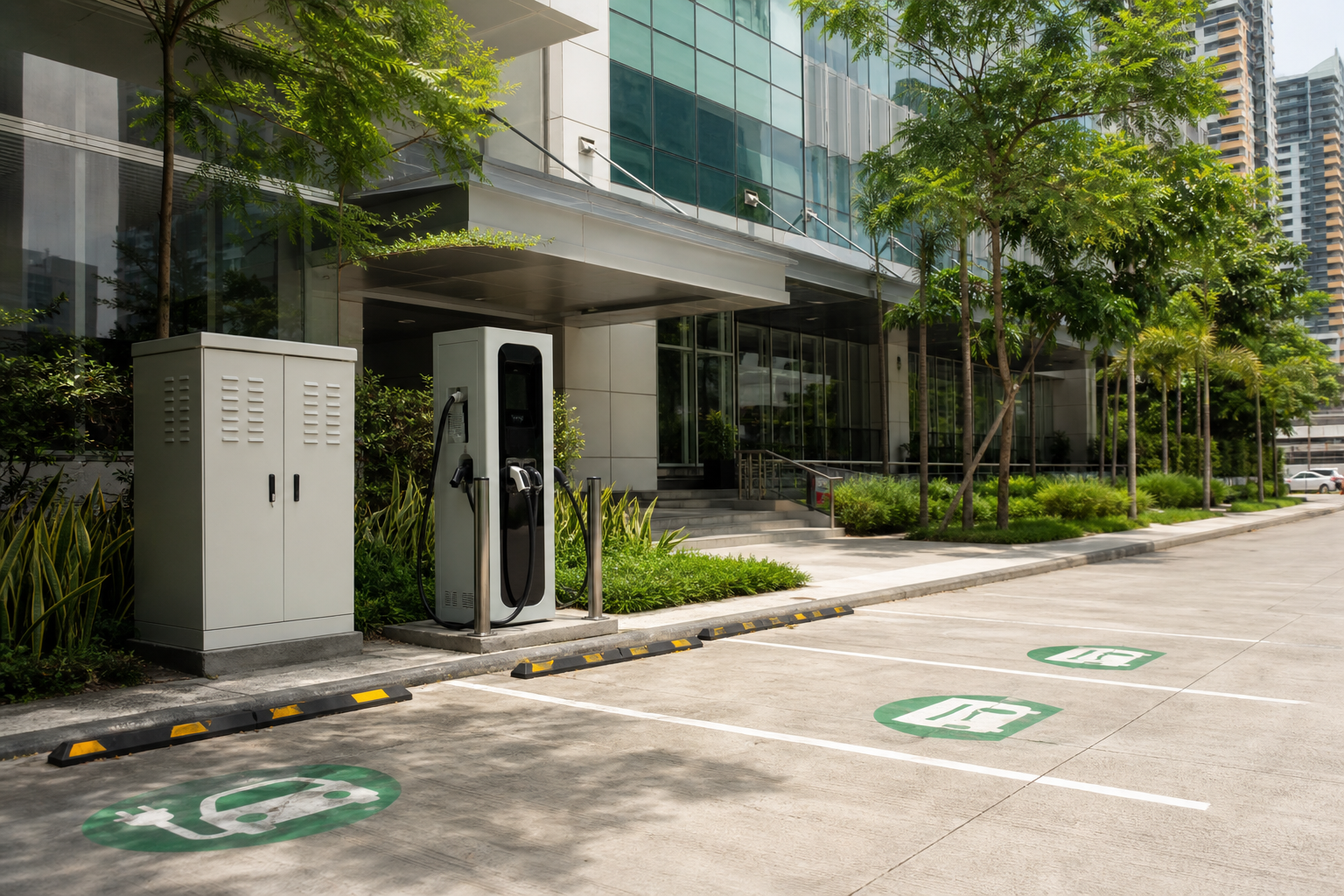
Reliability depends on more than the charger itself. Network connectivity, clear labeling, physical protection from vehicle impact, CCTV coverage in parking areas, and a maintenance contact all contribute to a safer experience. A charging bay that is easy to find, properly lit, and monitored is more useful than a poorly placed unit that creates hazards or operational confusion.
Better experience for families, employees, and tenants
For homeowners, an EV-ready garage or parking area can support daily convenience and long-term property value. For offices, charging access can improve employee satisfaction and help attract sustainability-minded teams. For commercial properties and residential developments, EV readiness can differentiate the location in a competitive market. The point is not to turn every site into a public charging hub. The point is to match the charging solution to actual use: private home charging, staff charging, visitor charging, tenant charging, or controlled fleet charging.
Different users need different policies. Families may prioritize overnight charging and safe cabling. Office managers may prioritize time limits and access for authorized employees. Property managers may need a request process, billing model, and maintenance schedule. Fleet operators may need reports, assigned bays, and contingency plans. A professional setup recognizes these differences before hardware is installed.
Decision-making guidance for property leaders
A practical EV readiness review should answer several questions. How many users are likely to charge in the next one to three years? Is the existing electrical system ready for the load? Where can chargers be installed without blocking circulation or creating hazards? What access rules are needed? Will the solution need usage reports or billing support? Who will maintain the equipment?
These questions help prevent underbuilt installations, overloaded circuits, poor placement, and unclear operating policies. They also help decision-makers phase investments. A site may begin with electrical assessment and parking design, then add one charging point, then expand as demand becomes measurable. That phased approach keeps capital spending aligned with real adoption while avoiding expensive emergency retrofits later.
A future-ready property is planned, not improvised
The best EV projects are not rushed responses to a single request. They are planned as part of a property’s broader technology, safety, and operations roadmap. That roadmap may include electrical upgrades, CCTV coverage for parking areas, access management, emergency procedures, network connectivity, and maintenance schedules. When these systems are considered together, EV charging becomes easier to operate and easier to scale.
For Metro Manila homes and offices, this joined-up planning is especially important because space, power capacity, parking flow, and security all matter. A well-planned charging area can improve the property experience. A poorly planned one can create disputes, clutter, hazards, and avoidable downtime.
How Infotouch can help
Infotouch supports homes, offices, and managed properties that want practical, reliable technology solutions for modern living and business operations. If you are evaluating EV readiness, charging convenience, secure parking, access control, or smart infrastructure for a Metro Manila property, Infotouch can help you assess requirements, plan the right approach, and implement solutions that are safe, scalable, and easy to manage.
Contact Infotouch to discuss how your home, office, or facility can prepare for the next stage of everyday mobility. With the right planning, EV readiness can become more than a sustainability statement. It can become a practical advantage for convenience, cost visibility, property value, and long-term operational resilience.
- Confirm available electrical capacity before adding chargers.
- Plan safe access, parking flow, and usage policies.
- Use reliable monitoring and support so charging stays predictable.
- Choose scalable infrastructure that can grow with demand.
Infotouch helps homes, offices, and property teams approach EV charging with practical planning, reliable technology, and safety-focused implementation.