
Electric vehicles are no longer a distant technology trend. For households, office managers, property administrators, and business owners in Metro Manila, the more practical question is no longer whether EVs will become part of daily mobility, but whether homes and workplaces are ready to support them safely and conveniently. EV adoption is being shaped by rising interest in cleaner transport, tighter operating cost control, improved charging options, and the need for modern properties to meet the expectations of residents, employees, customers, and fleet users.
That makes EV charging readiness a facilities decision as much as a mobility decision. A reliable charging setup can make daily EV use predictable for families, reduce avoidable downtime for business vehicles, improve tenant and employee experience, and demonstrate a practical commitment to sustainability. For Infotouch customers and partners, the opportunity is to approach EV charging with the same discipline used for security, connectivity, power protection, and business continuity: plan the infrastructure, manage access, monitor usage, and choose solutions that remain dependable as needs grow.
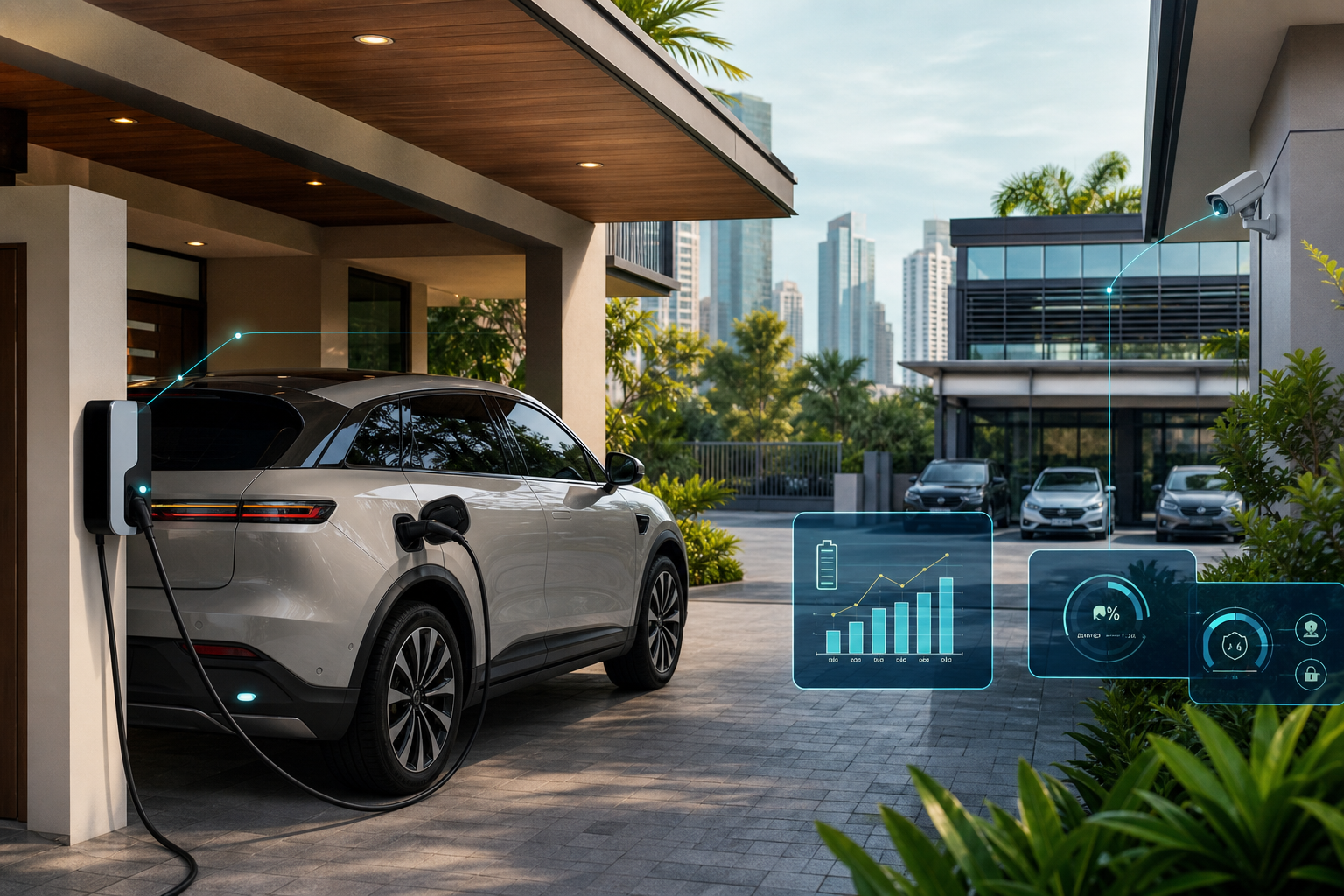
Why EV readiness matters now
The value of EVs today is increasingly practical. Owners want lower day-to-day energy costs compared with traditional fuel spending, the convenience of charging where they already live or work, and a quieter, cleaner operating experience. Businesses are looking at EVs for service vehicles, executive transport, delivery support, site operations, and employee benefits. Property managers are also seeing that charging access can influence how modern a building feels, especially in condominiums, office towers, logistics facilities, schools, healthcare sites, retail centers, and residential developments.
Metro Manila’s traffic patterns make predictability especially valuable. A vehicle that can charge overnight at home or during office hours avoids unnecessary detours and reduces dependence on ad hoc charging stops. For families, this can mean starting each day with sufficient range for school runs, errands, and office commutes. For companies, it can mean better control over vehicle availability, more transparent energy spending, and fewer interruptions during operating hours.
Convenience is the first business case
The most immediate advantage of a well-planned EV environment is convenience. Home charging allows residents to treat charging like charging a phone: plug in during predictable windows and leave with confidence. Office charging gives employees, executives, visitors, or fleet users the ability to top up while parked for meetings or work shifts. For facilities teams, the goal is not simply to install a charger; it is to make charging easy to use, safe to manage, and aligned with the building’s electrical capacity.
In practice, that means selecting the right charging location, protecting equipment from weather and unauthorized access, applying clear parking rules, and ensuring the charging point does not create congestion. A condominium might begin with a few shared chargers and usage policies for residents. A small office may reserve charging for company vehicles and scheduled employee access. A larger property may need multiple charging bays, user authentication, load management, and reporting for cost allocation. The best design depends on how the site operates, who will use the chargers, and how demand may grow over the next several years.
Cost control and ownership advantages
EVs can support better cost control when charging is planned correctly. Instead of relying only on fuel receipts and variable fuel prices, homes and businesses can monitor electricity consumption, schedule charging at more efficient times where applicable, and allocate charging costs to the right user, department, tenant, or vehicle. This is especially helpful for businesses operating multiple vehicles or shared parking facilities where unmanaged charging can quickly create confusion.
For fleet and office use, charging data can improve decision-making. Managers can compare energy use by vehicle, identify underused or overloaded charging points, and decide when additional capacity is justified. Property managers can set fair usage policies and avoid disputes by using access control and transparent reporting. Households can also benefit from understanding charging patterns, especially when EV charging is part of a wider home energy strategy that includes backup power planning, smart monitoring, or future solar integration.

Safety, reliability, and power planning should come first
Reliable EV charging is not only about the charger itself. It depends on proper electrical assessment, safe installation, circuit protection, cable management, ventilation considerations where relevant, weather resistance, and ongoing maintenance. A charger placed in the wrong location or connected without adequate capacity planning can create inconvenience, nuisance tripping, equipment damage, or safety risks. For offices and commercial sites, poor planning can also affect other building loads and create operational friction for tenants or departments.
This is why EV charging should be treated as a managed infrastructure layer. Facilities teams should review panel capacity, expected simultaneous charging demand, peak usage windows, parking layout, network connectivity, access control, and monitoring requirements. In some cases, phased deployment is the most sensible approach: install a small number of chargers now, prepare conduits or capacity for expansion, and use real utilization data before scaling. This avoids overinvestment while still positioning the property for future demand.
A better experience for residents, employees, and customers
EV charging can also improve the experience people associate with a property or business. For residential communities, charging access can be a meaningful convenience for families planning their next vehicle purchase. For offices, it can support employee retention, executive mobility, visitor experience, and corporate sustainability goals. For retail and service locations, charging can extend dwell time and signal that the site is keeping pace with modern customer expectations.
The key is to set expectations clearly. Users should know who may charge, how long they may park, whether there are fees, how to report issues, and what happens if a charging bay is blocked. Good signage, access management, CCTV coverage, and remote monitoring can help protect the equipment and reduce misuse. In higher-traffic sites, charging readiness should be coordinated with parking operations and security procedures, not treated as a standalone amenity.
Fleet and business applications are becoming more practical
For businesses, EVs are most compelling when they match predictable routes and charging windows. Service teams, campus vehicles, delivery support units, administrative transport, and facilities vehicles can benefit when they return to the same site regularly. With workplace charging, the business can reduce dependence on public charging availability and gain more control over readiness for the next shift. This is not about lifestyle positioning; it is about operational planning, uptime, and cost visibility.
Decision-makers should start by mapping actual vehicle use. Which vehicles have predictable daily mileage? Which ones return to base overnight? Which routes create the highest fuel cost or maintenance burden? Which sites have enough parking and electrical capacity to support charging? The answers help identify where EV adoption will deliver practical value now and where infrastructure should be prepared for future deployment.
What to consider before installing EV charging
A strong EV charging plan should cover capacity, safety, access, scalability, and support. Homeowners should confirm that the electrical system can safely support the selected charger and that installation is performed with proper protection and code-aware workmanship. Office and commercial properties should also consider user authentication, billing or reimbursement processes, network monitoring, maintenance response, and cybersecurity for connected charging systems. If chargers are networked, they should be managed with secure credentials, firmware updates, and appropriate separation from sensitive business systems.
For property managers, the most important early decision may be governance. Charging bays need rules. Electrical usage needs accountability. Maintenance needs ownership. Expansion needs a roadmap. When these are defined early, EV charging becomes a reliable property capability rather than a source of operational disputes.
Turning EV adoption into a practical infrastructure advantage
EV adoption is moving from novelty to practical infrastructure planning. Families want dependable charging at home. Employees and executives want workplace convenience. Businesses want cleaner operations, cost visibility, and fleet readiness. Property managers want to future-proof sites without creating unmanaged electrical or parking issues. The organizations that benefit most will be those that plan early, install safely, monitor intelligently, and scale based on real usage.
Infotouch helps homes, offices, and businesses think through technology infrastructure with reliability, security, and operational continuity in mind. If you are evaluating EV charging readiness for a residence, office, building, or fleet facility in Metro Manila or nearby areas, contact Infotouch to discuss a practical deployment approach that aligns with your property, users, power environment, and long-term technology plans.