For many Metro Manila businesses, CCTV used to be treated as a site-level system: cameras, a recorder in the back office, and footage reviewed only after an incident. That model is changing quickly. As companies operate across multiple branches, warehouses, offices, clinics, construction sites, and retail locations, video is becoming part of a broader business continuity and risk management strategy. The strongest current shift is not simply “more cameras.” It is the move toward hybrid cloud CCTV storage: keeping critical recording on a local NVR while adding secure cloud access, off-site backup, centralized visibility, and smarter retention policies.
This matters now because security teams are being asked to do more with the same headcount. Facilities are open longer, logistics and delivery operations are more distributed, and managers expect to verify events from anywhere. At the same time, local recorders remain vulnerable to power issues, network outages, device failure, tampering, theft, flooding, and accidental misconfiguration. A camera system that records only inside one site can leave a business blind at exactly the moment evidence is most valuable.

Hybrid cloud CCTV storage for business continuity
Why hybrid storage is gaining momentum
Purely local CCTV still has advantages: predictable recording, no dependence on internet bandwidth for every camera stream, fast playback inside the premises, and lower recurring costs for high-volume footage. Pure cloud video also has advantages: remote access, easier multi-site management, off-site protection, and simpler sharing with authorized stakeholders. The reason hybrid storage is gaining attention is that businesses increasingly need both.
In a hybrid design, the NVR continues to record on-site for day-to-day operations and high-resolution retention. Cloud services are then used selectively: event clips, bookmarked incidents, health alerts, snapshots, remote viewing, user access logs, or backup footage for the most sensitive cameras. This approach is practical for Philippine business environments where internet reliability, upload speed, power conditions, and cost control must all be considered. It gives decision-makers resilience without forcing every site into an expensive cloud-only model.
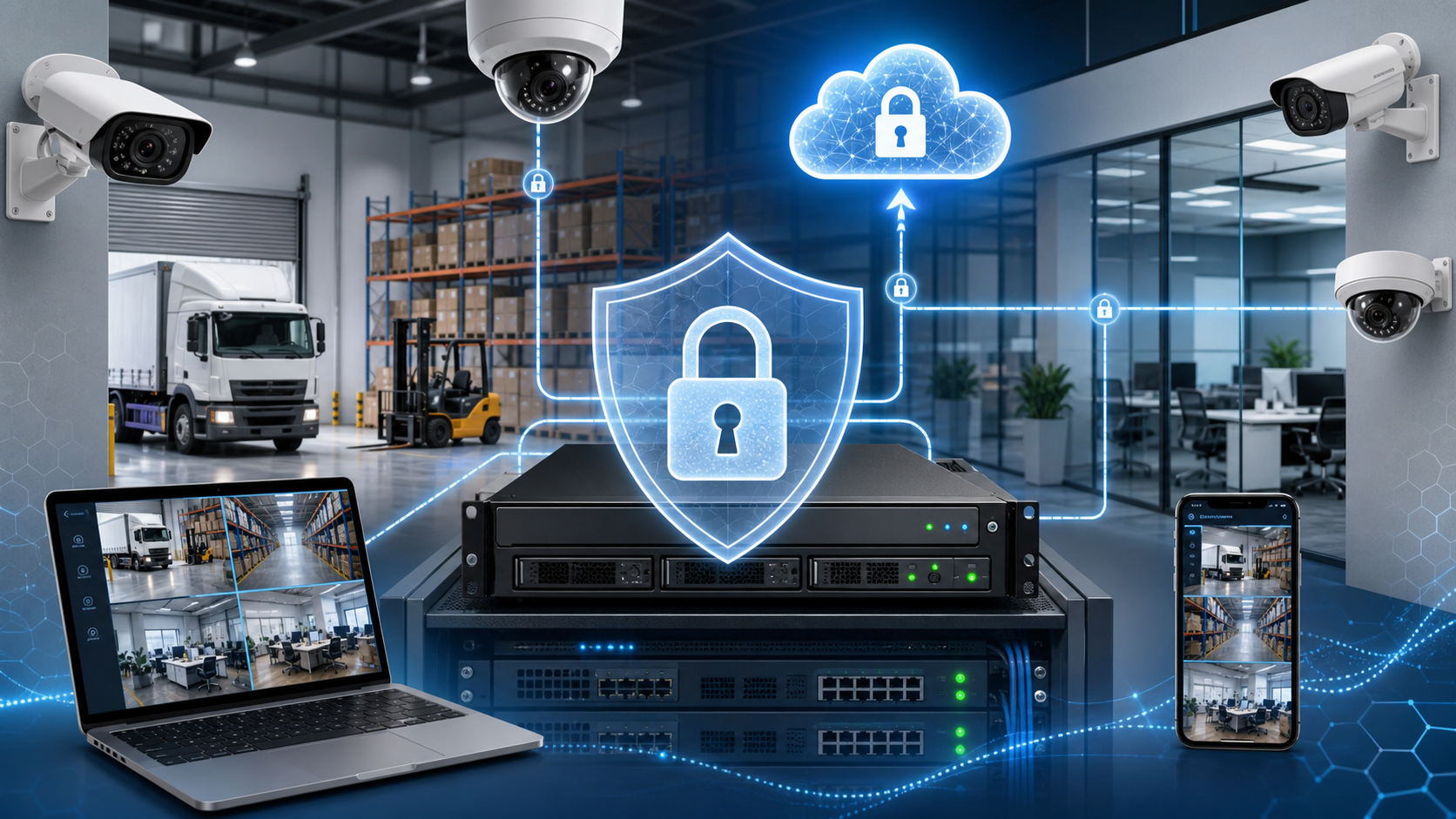
Hybrid CCTV architecture
For example, a retail chain may keep thirty days of continuous recording locally while sending motion-triggered clips from entrances, cash areas, stock rooms, and loading bays to a secure cloud repository. A warehouse may store high-resolution footage on the NVR but back up perimeter alerts and after-hours intrusion events. An office building may centralize lobby, elevator, parking, and server room clips for faster review by property management. These are not technology experiments; they are operational improvements tied directly to response time and evidence quality.
The business risk of relying only on local recording
Local NVRs are often placed in convenient locations rather than protected environments. If an incident involves an insider, a break-in, or a fire, the recorder itself may be damaged or removed. Even when the device remains intact, footage can be lost through hard drive failure, incorrect overwrite settings, weak passwords, or poor network segmentation. For organizations with multiple branches, another risk is delay: someone must physically visit the site or ask local staff to export video, which can slow investigations and create inconsistent evidence handling.
There is also a governance issue. Many businesses do not have a clear answer to basic questions: which cameras are recording, how long footage is retained, who can view it remotely, whether the timestamp is accurate, and whether the system is receiving firmware updates. As surveillance becomes more connected, these questions are no longer just facilities concerns. They affect IT security, privacy compliance, insurance claims, labor disputes, audit readiness, and customer trust.
Operational value beyond security
The ROI case for hybrid cloud CCTV is strongest when leaders view video as an operational asset, not only as a deterrent. Faster remote verification can reduce unnecessary dispatches. Centralized monitoring can help head office teams compare site conditions without waiting for manual reports. Incident clips can support training, safety reviews, stock discrepancy investigations, contractor management, and service quality checks.
Consider a distribution company with several small warehouses around Metro Manila and nearby provinces. If a delivery dispute occurs, the operations team needs to verify gate activity, loading sequence, vehicle movement, and handover timing. With a local-only system, evidence retrieval may depend on the availability and skill of on-site personnel. With a hybrid setup, authorized managers can review relevant clips quickly, preserve them before overwrite, and share them securely with the right stakeholders.
For property managers, hybrid storage also improves continuity during emergencies. If access to a building is restricted after a flood, fire, civil disturbance, or power event, cloud-backed clips and system health dashboards can still provide visibility into what happened before and during the disruption. For IT managers, the benefit is standardization: consistent camera naming, retention rules, user permissions, network policies, and maintenance routines across sites.
What businesses should modernize first
A practical upgrade does not need to replace every camera immediately. The first step is to identify which video is most business-critical. Entrances, receiving areas, cashier points, parking access, perimeter lines, server rooms, stock rooms, and executive or high-traffic areas usually deserve stronger retention and remote visibility. These camera groups can be prioritized for hybrid backup, better analytics, and tighter access controls.
Next, evaluate the current recorder and storage health. Many systems are technically “working” but have hidden weaknesses: aging drives, insufficient capacity for newer high-resolution cameras, missing RAID or backup strategy, poor time synchronization, default passwords, unsupported firmware, or no alert when recording stops. A short audit can reveal whether the existing NVR can support the next three to five years of business requirements.
Bandwidth planning is equally important. Hybrid cloud CCTV does not mean uploading every stream at full resolution all day. A well-designed system uses event-based upload, schedules, compression, camera-side analytics, and retention tiers. The goal is to protect the footage that matters most while keeping network performance stable for business applications such as POS, ERP, Wi-Fi, VoIP, and cloud productivity tools.
Cybersecurity and privacy cannot be afterthoughts
As CCTV becomes more cloud-connected, camera cybersecurity becomes part of enterprise risk management. IP cameras and NVRs should be isolated from guest Wi-Fi and general office traffic, protected with strong passwords and role-based access, and maintained with firmware updates. Remote access should avoid unsafe port forwarding where possible and use secure vendor platforms, VPN, or properly managed access controls. Logs should show who viewed, exported, or shared footage.
Privacy also matters. Businesses should define who may view live and recorded video, how long footage is retained, and how requests are handled. Signage, documented policies, and limited access help reduce misuse and support compliance expectations. For companies operating in customer-facing environments, responsible video management protects both the organization and the people being recorded.
A modern CCTV roadmap for Metro Manila businesses
The most effective roadmap starts with a site and risk assessment. Map cameras against business-critical areas, verify blind spots, test actual playback quality, review storage duration, and confirm whether footage can be retrieved after a local equipment failure. From there, choose a hybrid architecture that matches operational priorities: local NVR recording for continuous coverage, cloud backup for high-value events, remote monitoring for authorized teams, and analytics for faster detection.
Infotouch helps businesses approach CCTV modernization as an integrated IT and security project rather than a standalone camera purchase. That includes camera placement, NVR sizing, network readiness, secure remote access, storage planning, user permissions, and ongoing support. For organizations with multiple locations, the result is a more consistent and resilient surveillance environment that supports security, operations, compliance, and continuity.
The next step is straightforward: review your current CCTV storage and remote access setup before an incident exposes the gaps. If your business depends on local recording only, cannot confirm recorder health remotely, or struggles to retrieve footage across branches, hybrid cloud CCTV storage should be part of your 2026 security upgrade plan.